The Math Behind a Mowed Lawn: What It Really Costs to Keep One Neighbor’s Yard Maintained
June 19, 2026 · I Want To Mow Your Lawn
The Math Behind a Mowed Lawn: What It Really Costs to Keep One Neighbor’s Yard Maintained
A quarter-acre suburban lot, mowed every seven days during the growing season. Edging, trimming, blowing clippings off the driveway. Nothing fancy. Just regular lawn care—the kind most homeowners take for granted because it’s simply part of home ownership.
Lawns need attention roughly once every five to seven days during the active growing season—which stretches roughly 20–26 weeks depending on climate and region. That means a neighbor managing their yard professionally is looking at 15 to 26 mowing visits per year.
The math compounds quickly.
Annual Costs: When Mowing Becomes a Line Item
Annual lawn maintenance costs range from $900 to $4,000 per year for a quarter-acre yard, depending on the frequency of service and what’s included. A minimal maintenance approach—mowing only, every two weeks—lands around $900 per year for a modest suburban lot. Weekly mowing in regions with longer growing seasons can approach $2,000–$3,000 annually.
For those who lack the physical ability, health, energy, or time to do it themselves, the professional cost becomes unavoidable.
Who Gets Left Behind?
An older adult with arthritis. A veteran managing a service-connected disability. A neighbor working multiple jobs. A family stretched thin financially. These are the people for whom lawn care shifts from “household maintenance” to “financial burden.”
Many don’t have a choice: neglect the yard, or pay hundreds of dollars monthly for help. Neglected yards attract code violations, fines, and the stress of legal action. Paying for professional care crowds out other necessities.
This is where the economic math of lawn care meets dignity and community.
The Alternative: Volunteer Networks
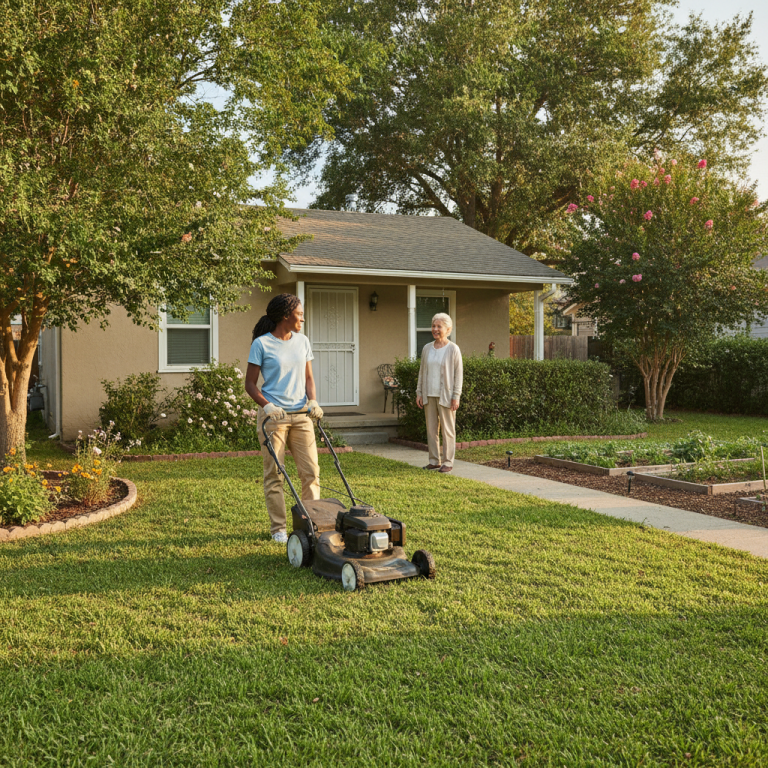
I Want To Mow Your Lawn operates across all 50 states with 1,800+ volunteers who provide exactly this service—free lawn and exterior home care—to older adults, veterans, and neighbors in need. A single volunteer visit eliminates that $55 from someone’s monthly budget. Multiple visits across the season mean real financial relief.
Volunteers don’t replace the professional lawn care industry. They bridge a gap that the market leaves open: the space where cost meets necessity, where dignity meets vulnerability, where a neighbor simply needs a hand.
The cost of professional lawn care is real. So is the reality that some neighbors can’t afford it. And so is the reality that a community of volunteers can show up and help shoulder that burden, one mowed lawn at a time.
What You Can Do
If a neighbor’s yard is slipping—overgrown, unmaintained, the kind of space that signals someone’s struggling—there’s no need to wait for a code violation or assume they’re being careless. Many older adults and veterans want to maintain their homes. They’re simply facing the same economic pressure that makes lawn care a luxury item rather than a standard part of home care.
Because the math isn’t just about dollars and cents. It’s about what happens when a community decides that every neighbor—regardless of age, ability, or income—deserves a well-kept home.
The Real Cost Breakdown: How to Calculate Lawn Care Expenses for Your Region
Lawn care pricing varies wildly by region, lawn size, and services included. This guide breaks down how professionals calculate costs, what factors drive the price up or down, and how to understand the full picture of what yard maintenance actually requires.
Understanding Professional Pricing Models
Professional landscapers use several pricing approaches, and understanding them helps clarify why lawn care is expensive—and why volunteer relief matters so much.
Per-Visit Pricing: Most residential lawn care operates on a per-visit model. A standard quarter-acre mowing costs $40–$80 depending on region, with the national average around $50–$55. This price typically includes mowing, edging, trimming, and blowing clippings off hard surfaces. Anything beyond that—bagging, haul-away, heavy brush clearing, or overgrowth recovery—is usually an additional charge.
Seasonal Frequency: The number of visits per season drives the annual total. During peak growing season (June–August), lawns may need weekly mowing. Spring and fall might drop to bi-weekly. A 20-visit season at $50/visit = $1,000. A 26-visit season = $1,300. Regional variations in growing season length significantly impact annual costs.
Regional Cost Variation: Where You Live Matters
Lawn care pricing is highly localized. Labor costs, climate, lawn density, and service competition all play a role:
Northeast: $65–$95 per quarter-acre visit (higher labor costs)
Midwest: $40–$75 per visit (more moderate pricing)
Southeast: $30–$55 per visit (lower cost of living)
Southwest: $35–$65 per visit (variable by metro area)
West Coast: $55–$100+ per visit (highest rates, especially California)
A neighbor in Providence, RI paying bi-weekly might hit $690/year on the low end. The same service in San Diego, CA could exceed $1,500 annually. Geography, not just lawn size, drives the financial burden.
What Factors Drive Costs Up?
Lawn Condition: An overgrown or neglected yard costs more on first visit (heavy mowing, debris removal). Ongoing maintenance is cheaper once the lawn is established.
Obstacles and Terrain: Uneven ground, trees, landscaping features, and decorative hardscaping all slow the work. A simple, open quarter-acre is faster (and cheaper) than the same size with multiple flower beds and walkways.
Add-On Services: Bagging and hauling clippings adds $10–$20 per visit. Edging flower beds instead of just lawn edges costs more. Trimming overgrowth or clearing debris bumps the price significantly.
Equipment Access: Properties requiring specialty tools or equipment (zero-turn mowers for slope, aerators, dethatcher) cost more than standard push-mower work.
Time Investment: The Hidden Component
A professional mowing crew typically charges hourly rates of $50–$90/hour, though most residential work is estimated as per-visit flat rates. A standard quarter-acre takes 30–45 minutes of actual work time, plus setup, travel, and cleanup. For a crew of two, that’s roughly 1–1.5 hours of labor per property.
At $60/hour labor cost and $30–$40/hour for equipment and overhead, a $55 per-visit charge covers the real cost. It’s not inflated. It’s the actual math of running a service business.
Why Volunteers Bridge a Critical Gap
Volunteers donate their time and effort—eliminating labor and overhead costs entirely. When a volunteer mows a neighbor’s lawn, that neighbor saves $50–$120 per visit, or $900–$3,000+ annually depending on region and frequency. That’s real economic relief for neighbors living on fixed incomes, managing disabilities, or facing other financial constraints.
Professional lawn care is a legitimate, necessary business. But it’s a business that prices out many of the neighbors most in need of help. Volunteer networks don’t replace that industry—they serve the neighbors that market leaves behind.
Support our foundation to unlock this resource
A donation of any amount unlocks all bonus guides, templates, and deep dives for 30 days.
100% goes toward connecting volunteers with neighbors in need.
Choose your donation amount
$
Choose how to donate:
I Want To Mow Your Lawn Inc. is a 501(c)(3) nonprofit and registered charity with PayPal Giving Fund. EIN: 85-3447661. Your donation is tax-deductible.
Have a group?Organize a Community Service Day — we'll match your team with neighbors who need help.
Want to help us reach more neighbors?Our Marketing Toolkit has copy-ready posts, press materials, and flyers you can share in five minutes.