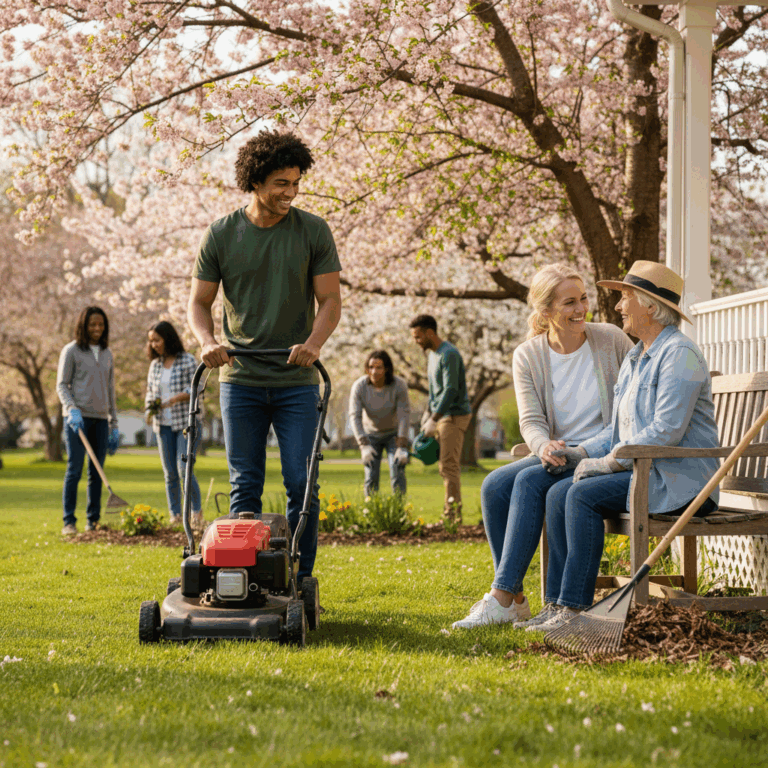
The Quiet Power of a Saturday Morning Outside
There’s something that happens when someone steps outside on a spring morning with a purpose. The air is different. The light hits differently. And for many who volunteer their time to help a neighbor, an older adult, or a veteran with yard work, that simple act—the physical movement, the fresh air, the tangible result of effort—becomes medicine in a way that’s hard to name but impossible to miss.
May is Mental Health Awareness Month, and the 2026 theme is “More Good Days, Together.” It’s an invitation to think about what makes a day feel good, and what role community plays in that feeling. For volunteers and the people they serve alike, outdoor volunteering is often part of that answer.
The Research Behind the Relief
The connection between volunteering and mental health is well-established. A comprehensive 2024 review examined 28 systematic studies and found that volunteering produces measurable benefits across mental, physical, and social health, with reduced depression and increased life satisfaction showing particularly strong effects.
The specific numbers are striking. A university researcher studying the volunteering-health connection reports that compared to non-volunteers, those who volunteer have less depression, less anxiety, higher self-esteem, higher life satisfaction, greater happiness, and a greater sense of meaning in life. One study found that participants with mild-to-moderate depression showed a 19% decrease in depressive symptoms after a volunteering intervention—above the threshold for clinically meaningful improvement.
Notably, volunteering particularly lowers depression for older adults, and the benefits are not limited to traditional organized service—informal helping, like mowing a neighbor’s lawn, counts. The Census Bureau reports that over 137 million Americans engaged in informal helping between 2022 and 2023, with many citing yard work and neighborhood support as their primary form of service.
Why Outdoor Work Matters Specifically
Not all volunteering is equal when it comes to mental health. Research from Harvard’s T.H. Chan School of Public Health notes that outdoor volunteers gain perspective on their own challenges and report better physical health outcomes—older adults who volunteer outdoors are able to walk longer and have better balance than their sedentary peers. The combination of physical activity, nature exposure, fresh air, and purposeful work creates a compounding effect.
There’s also a magic in seeing results. Mowing a lawn, trimming a hedge, clearing debris—these are tasks with immediate, visible outcomes. A volunteer finishes, steps back, and sees the difference. That person helped make that difference. For someone struggling with depression, anxiety, or a sense of disconnection, that clarity can be profound.
The Sweet Spot: How Much Volunteering Helps
The research also offers guidance on timing. Studies suggest that 2–3 hours per week of volunteering can provide the most mental health benefits, as long as the activity feels rewarding. One recent study found that both formal and informal helping linked to slower cognitive decline with just 2–4 hours weekly. This is important: volunteering doesn’t need to be a massive time commitment to move the needle. A Saturday morning helping a neighbor is enough.
What About the People Being Served?
The mental health benefits aren’t one-sided. Older adults, veterans, and neighbors who receive help often experience their own relief—not just physical relief from the burden of yard work, but emotional relief from knowing their community still sees them, still helps, still cares. That connection itself is powerful medicine.
A Moment for Reflection
As May invites reflection on what “more good days, together” means, outdoor volunteering offers a concrete answer. It’s low-barrier, immediately purposeful, and grounded in human need. It requires no special training to start. And the evidence is clear: it helps both the giver and the receiver.
For anyone considering volunteering—whether to improve their own mental health, to serve a specific neighbor or veteran, or simply to be part of something larger than themselves—outdoor volunteering is a place to start. The grass needs mowing. The yard needs clearing. And someone nearby probably needs help.
I Want To Mow Your Lawn connects volunteers across all 50 states with older adults, veterans, and neighbors who need free yard care relief. Volunteers can sign up to help, and those needing support can request assistance. For a lighter entry point, the MOW app offers a simple way to explore the mission and stay connected to the community.
More good days. Together. It starts with showing up.
Printable Guide