From Monoculture to Meadow: Why Native Plants Matter More Than a Perfect Lawn
July 19, 2026 · I Want To Mow Your Lawn
From Monoculture to Meadow: Why Native Plants Matter More Than a Perfect Lawn
There’s a quiet shift happening in American yards. Not everywhere yet, but enough to notice. In neighborhoods across the country, patches of turfgrass are giving way to wildflowers, native shrubs, and unmowed meadows. Not out of laziness—though that’s a welcome side effect—but out of something deeper: a growing recognition that the traditional American lawn is broken.
The standard lawn, inherited from European estates and perfected by post-war suburbia, is a monoculture. A single species of non-native grass, kept short, kept green, kept alive through relentless inputs of water, chemicals, and fuel. It’s beautiful in a uniform way. It’s also an ecological dead zone.
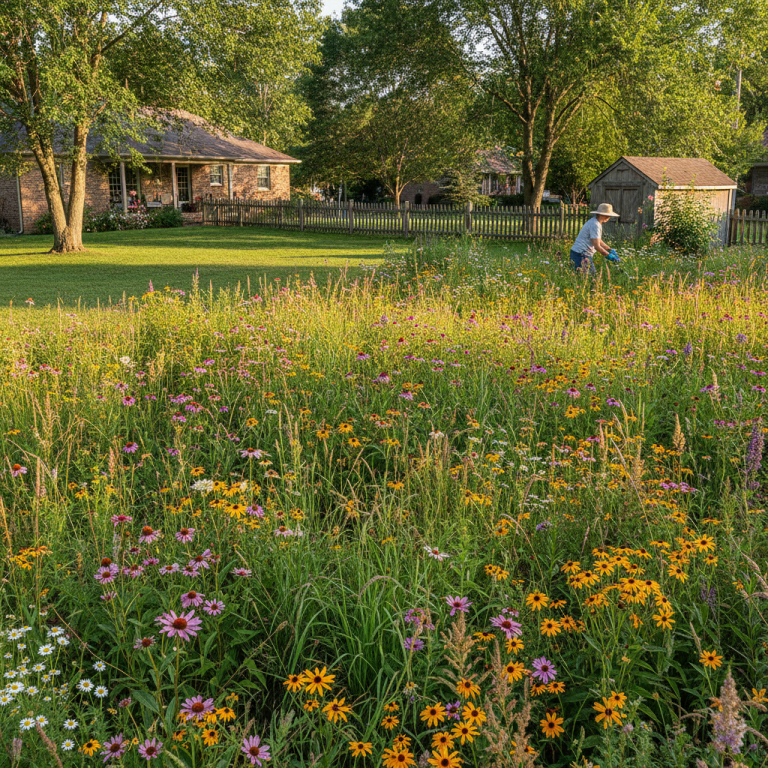
Native plants and no-mow meadows aren’t just less work. They’re fundamentally different ecosystems—ones that actually support life.
Native wildflowers, grasses, and shrubs evolved alongside local pollinators, birds, insects, and soil microorganisms. When these plants return to a yard, so does the web of life that depends on them. A meadow becomes a food source, a breeding ground, and a shelter. Bees find pollen and nectar. Birds find insects and seeds. Soil organisms build fertility naturally, without added fertilizer.
The water infiltration is another quiet win. Native plants, especially those with deep root systems, absorb rainfall where it falls instead of letting it run off as stormwater. This reduces flooding, recharges groundwater, and cuts municipal stormwater management costs. The lawn, by contrast, with its shallow roots and compacted soil, sheds water like a parking lot.
Starting Small
The transition doesn’t have to be all-or-nothing. Many households start by converting a small section—a corner bed, a side yard, or the area under a tree where grass never grew well anyway. A few native shrubs and perennials, left largely untended, can create measurable ecological benefit in a single season.
Others experiment with “no-mow zones”—areas of the lawn designated to grow taller, flower, and support insects. This requires neither removing turf nor replanting. It simply means stopping mowing in certain sections and watching what emerges.
For older adults, veterans, and neighbors managing physical limitations or tight budgets, this shift can feel especially liberating. Less lawn means less mowing, less watering, fewer chemicals to handle. It’s a form of freedom.
A Volunteer Perspective
I Want To Mow Your Lawn recognizes that lawn care, when it becomes burdensome, affects physical and mental well-being. Across all 50 states, 1,800+ volunteers connect with neighbors who need temporary relief. But the conversation is also quietly shifting. Some volunteers help yards transition away from resource-intensive turf entirely—planting native species, mulching over unused sections, or simply letting a corner of a property rest and rewild.
This approach aligns with the organization’s core value: meeting neighbors where they are and reducing the burden that outdoor maintenance can become.
The Bigger Picture
No individual yard will solve a biodiversity crisis or solve drought. But yards are scale. Lawns cover more than 63,000 square miles—nearly the size of Texas. If even a fraction of that expanse converted to native plants and meadow, the ecological benefit would be measurable. Pollinator populations would recover. Stormwater would infiltrate. Chemical runoff would drop. Air quality would improve.
The American lawn was never inevitable. It’s a choice, remade every season. And the choice is beginning to shift.
If yard maintenance has become overwhelming, or if there’s interest in exploring alternatives to traditional turf, volunteers with I Want To Mow Your Lawn are ready to help. For those curious about learning more—or testing ideas—the MOW app offers tips, community stories, and practical guidance for yard work at any age or ability level.
The Practical Guide to Converting Turf to Native Plants: A Step-by-Step Approach
Ready to transition part of a yard away from traditional lawn? This guide walks through site assessment, native species selection, installation methods, and the first-year maintenance timeline—with specific techniques that work for yards of any size or ability level.
Site Assessment: Understanding What You Have
Before planting anything, spend time observing the yard. How much sun does each area receive? Is the soil clay, sandy, or loam? Does water pool after rain, or does it drain quickly? Does the area stay moist, or does it dry out fast? Native plant success depends entirely on matching plants to existing conditions rather than forcing conditions to match the plants.
A simple sketch mapping sun exposure (full sun, partial shade, full shade) and moisture patterns (wet, average, dry) takes 20 minutes and saves months of frustration. Many native plants are site-specific, and a plant thriving in one neighbor’s yard may fail in another’s due to subtle differences in soil and microclimate.
Choosing Native Species: Start Local
Native doesn’t mean “any plant that grows here.” It means plants that evolved in the specific region and support local insects, birds, and soil life. A plant native to California may be invasive in Texas. Native plant societies, usually organized by state or region, publish lists of species suited to local conditions. Most are free online.
When selecting, think in layers: canopy trees (if appropriate), understory shrubs, and herbaceous perennials. Diversity in height and bloom time extends the food source for pollinators throughout the growing season. Aim for a mix of species that bloom spring through fall, so something is always flowering.
Start small—a 100-square-foot bed is more manageable than converting an entire yard. Success breeds confidence and momentum.
Removal and Soil Preparation
Removing turf can be done several ways. The simplest is “solarization”: cover the area with cardboard or thick landscape fabric for 4-6 weeks during warm months. The grass dies underneath from heat and light deprivation. Once dead, either remove the cardboard and plant directly into the softened soil, or leave it in place and cut planting holes through it. The cardboard decomposes over the following season.
Alternatively, use a flat shovel to slice under the sod in strips, fold it back, and compost or repurpose it elsewhere. This is more labor-intensive but faster.
Most native plants don’t require amended soil—in fact, overly rich soil can cause some species to sprawl or become too leafy. If the soil is extremely compacted, loosen the top 6-8 inches with a garden fork. Otherwise, minimal preparation is ideal.
Planting: Spacing and Depth
Follow label instructions for spacing—resist the urge to plant densely. Native perennials fill in quickly once established. A bed that looks sparse in year one will be full by year two or three. Overly dense planting leads to competition and fungal issues.
Plant at the same depth the plant was growing in its nursery pot. Planting too deep invites root rot. Water gently after planting to settle soil, then water regularly (2-3 times per week) for the first 4-6 weeks until roots are established. After that, most natives in average soil need supplemental water only during extended drought.
First-Year Maintenance and Realistic Expectations
The first year after planting is the “establishment” phase. Plants are building roots, not necessarily growing visibly above ground. This is normal. Keep the area free of competing weeds by hand-pulling (don’t use herbicides—they harm the native plants). A 2-3 inch layer of shredded wood mulch suppresses weeds and moderates soil temperature, but keep mulch a few inches away from plant stems to prevent rot.
In year two and beyond, most native plantings need minimal intervention. No fertilizer. No pesticides. Deadheading spent flowers extends bloom time but isn’t necessary—seed heads feed birds and provide winter structure. In late fall or early spring, cut back herbaceous perennials to the ground level. Shrubs may need light pruning to maintain shape, but heavy pruning is rarely necessary.
No-Mow Zones as an Alternative
Not ready to remove turf? Start by designating one or more “no-mow zones”—areas, perhaps 50-200 square feet, where mowing stops. Some of the existing grass will flower (yes, lawn grasses have flowers; we just don’t usually see them because we mow). Native wildflower seeds in the soil will germinate and grow taller. Within one season, the zone will support insects and visual diversity without any replanting.
Connecting the Knowledge to Helping Neighbors
Volunteers helping neighbors maintain yards often encounter older adults or veterans hesitant to ask for ongoing help with traditional lawn care. Introducing the idea of a low-maintenance native garden or no-mow zone can shift the conversation entirely—from “I need help maintaining what I have” to “I could reduce what I need to maintain.” This respects both the dignity of the person served and the finite capacity of volunteer networks. A yard that transitions toward self-sufficiency is ultimately more sustainable and more empowering than one locked in a cycle of external maintenance dependency.
Support our foundation to unlock this resource
A donation of any amount unlocks all bonus guides, templates, and deep dives for 30 days.
100% goes toward connecting volunteers with neighbors in need.
Choose your donation amount
$
Choose how to donate:
I Want To Mow Your Lawn Inc. is a 501(c)(3) nonprofit and registered charity with PayPal Giving Fund. EIN: 85-3447661. Your donation is tax-deductible.
Have a group?Organize a Community Service Day — we'll match your team with neighbors who need help.
Want to help us reach more neighbors?Our Marketing Toolkit has copy-ready posts, press materials, and flyers you can share in five minutes.