What to Do When You Notice a Neighbor Who Needs Help (But Hasn’t Asked)
July 29, 2026 · I Want To Mow Your Lawn
What to Do When You Notice a Neighbor Who Needs Help (But Hasn’t Asked)
There’s a moment many people recognize in their neighborhood: a yard that’s grown wild, gutters that haven’t been cleaned, grass that’s become hard to manage. The person living there might be aging in place, recovering from an injury, dealing with a health condition, or simply overwhelmed. But they haven’t asked for help—and they might never.
This is one of the hardest parts of community. Noticing need is easy. Responding to it without overstepping, without making someone feel pitied or burdened, requires intention and care.
Older adults who have lived independently for decades may see asking for help as a loss of control. Veterans, in particular, report high rates of isolation—56.9% of U.S. veterans report feeling lonely some of the time or often—and may be especially resistant to acknowledging need. Adults living alone, who now make up 21% of U.S. adults age 50 and older, face yard care challenges without a built-in support system at home.
July brings another layer of urgency. Summer heat poses real risks to older adults doing outdoor work, yet many push through rather than admit they can’t safely manage their yards anymore.
Signs That a Neighbor Might Be Struggling
The yard itself: Grass growing knee-high, weeds overtaking flower beds, branches hanging over the roof, gutters clogged with leaves.
The person: Less visible than usual, moving more slowly, or expressing frustration about yard work during casual conversation.
The circumstances: Recent loss, a health setback, a visible injury or mobility issue, or living alone with no apparent family nearby.
Age or status: Older adults aging in place, veterans, or people managing chronic illness often face hidden barriers to outdoor maintenance.
How to Start the Conversation
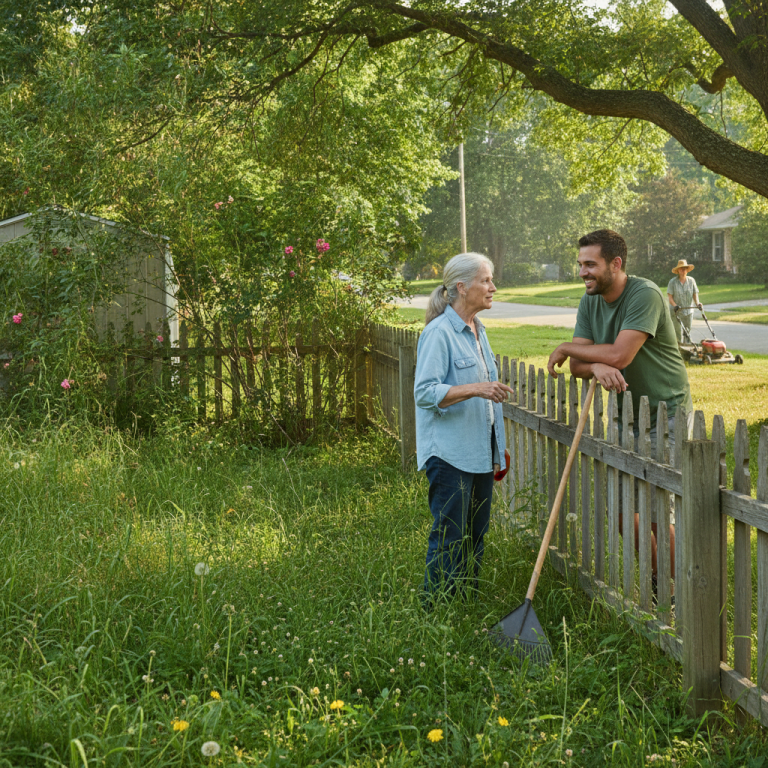
Be direct, but not alarming. Don’t corner them or make it a big deal. A neighbor-to-neighbor chat works best: “Hey, I noticed your gutters could use cleaning. I have some free time this weekend—would that be helpful?” Simple. Specific. Respectful.
Lead with a skill or resource, not charity. Instead of “You need help,” try “I’m planning to tackle my yard this weekend and have some extra tools/time. Can I swing by yours too?” This frames the offer as convenience, not pity.
Mention free, local options. I Want To Mow Your Lawn connects volunteers in all 50 states with older adults, veterans, and neighbors who need free lawn and exterior home care relief. If your neighbor is hesitant about accepting help from you personally, knowing that an organized network of volunteers exists—people who are trained, insured, and motivated purely by neighborliness—can make the ask feel less like a burden and more like a resource they’re entitled to.
Respect their answer. Some people will decline. Some will accept once but not again. That’s okay. The goal isn’t to rescue someone; it’s to offer relief and remind them they’re not invisible.
A Practical Next Step
If the neighbor is open to help, consider connecting them with I Want To Mow Your Lawn’s volunteer network. The organization has 1,800+ volunteers standing by to provide free temporary relief with yard work and exterior home care—no strings attached, no obligation for recurring service. Volunteers are just neighbors who want to help.
There’s also the MOW app, available to play online or download from the App Store, which gamifies the experience of helping neighbors and building community awareness.
Noticing someone’s struggle and acting on it—with grace and respect—is what neighborliness looks like. It doesn’t require grand gestures. It requires attention, and the courage to show up.
The Conversation Starter’s Toolkit: Scripts and Strategies for Approaching a Neighbor in Need
Wanting to help and knowing how to ask are two different things. This guide gives you word-for-word conversation starters, timing tips, and follow-up strategies to make the offer of help feel natural—not awkward or patronizing.
Before You Approach: Read the Room
Timing and tone are everything. Avoid catching someone when they’re visibly stressed, rushing, or in a bad mood. Early morning or late afternoon, when people are more relaxed, works better. A casual chat over the fence or mailbox beats a formal knock on the door.
Start with observation, not assumption. You’ve noticed something—that’s all you need to mention. Don’t diagnose their problems (“You’re getting old” or “You must be struggling”). Just name what you see and offer a practical solution.
Word-for-Word Conversation Starters
For visible yard neglect: “Hey, I’m planning to mow and trim this weekend. Your yard could use the same—want me to swing by afterward?”
For health or mobility concerns: “I know [task] can be tough on your back/knees/etc. I’m doing mine anyway—happy to grab yours too.”
For older adults or veterans: “I volunteer with a group that helps neighbors with yard work. Would you be open to that?”
For someone living alone: “Yard work is a lot to handle solo. Have you heard of [local resource]? They connect volunteers to help with exactly this.”
What NOT to Say
“Your yard is a mess.” (Shame, not solution.)
“You must be struggling.” (Assumption, not empathy.)
“I feel sorry for you.” (Pity, not partnership.)
“Don’t worry, I’ll fix it for you.” (Removes agency.)
“You’re lucky I noticed.” (Makes help transactional.)
The Follow-Up: Respecting Their Answer
If they say yes, be specific: “I’ll stop by Saturday morning around 9. Should take me about an hour. No need to be home if that’s easier for you.” This removes pressure and gives them control.
If they decline, don’t push. Try once more, gently, and then let it go. Sometimes people need to be asked twice. Sometimes they need to come to the realization on their own timeline. Plant the seed—mention the free volunteer network as a standing option—and respect their autonomy.
Making It Feel Natural, Not Awkward
Partner with them, don’t rescue them. Frame it as “I’m doing mine anyway” rather than “Let me do yours.” This preserves dignity and makes the help feel incidental, not sacrificial.
Offer specifics, not vague support. “Can I mow your front lawn?” is easier to accept than “Is there anything I can do?” Specificity removes ambiguity and makes accepting easier.
Give them an out. “No pressure at all” or “Only if you’re comfortable” signals that you’re offering, not obligating. People are more likely to accept when they feel the choice is theirs.
Resources to Share
If someone is hesitant to accept help directly from you, offering a third-party option removes the personal debt feeling. I Want To Mow Your Lawn, with 1,800+ volunteers across all 50 states, provides free temporary relief without strings. It’s a gift your neighbor didn’t have to ask for—and that changes everything psychologically.
Knowing these resources exist—and having practiced how to mention them—means you can help a neighbor feel supported, not surveilled. That’s the difference between noticing need and building real community.
Support our foundation to unlock this resource
A donation of any amount unlocks all bonus guides, templates, and deep dives for 30 days.
100% goes toward connecting volunteers with neighbors in need.
Choose your donation amount
$
Choose how to donate:
I Want To Mow Your Lawn Inc. is a 501(c)(3) nonprofit and registered charity with PayPal Giving Fund. EIN: 85-3447661. Your donation is tax-deductible.
Have a group?Organize a Community Service Day — we'll match your team with neighbors who need help.
Want to help us reach more neighbors?Our Marketing Toolkit has copy-ready posts, press materials, and flyers you can share in five minutes.