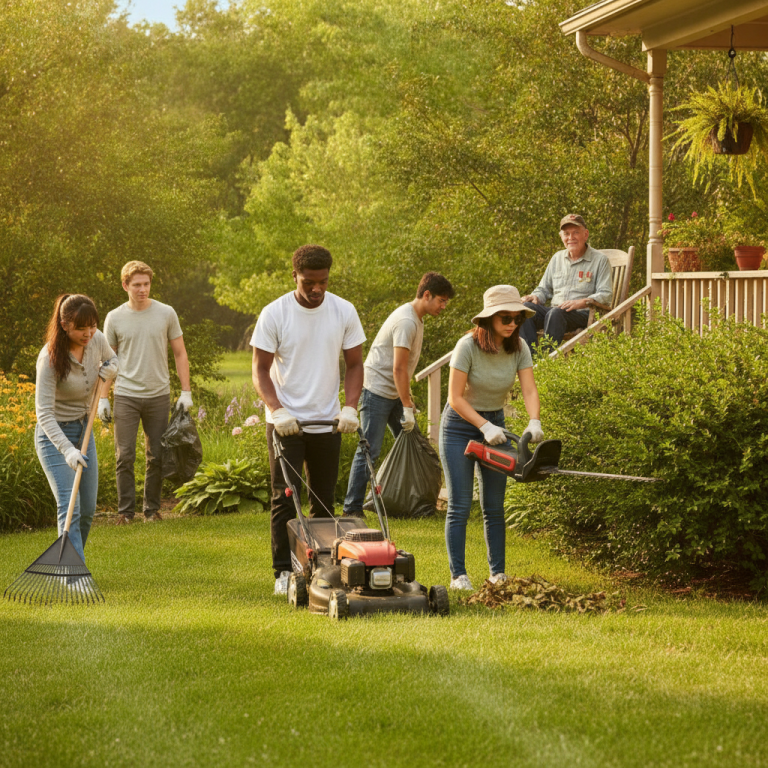
The Real Value of Outdoor Volunteering on a Summer Resume
A high school student faces a familiar summer dilemma: 60 hours of service-learning required before graduation. The deadline feels distant until late June, when reality sets in. The student could scroll through generic nonprofit opportunities, or consider something more tangible—work that produces visible results, builds genuine skills, and fills a real community need.
Lawn care volunteering offers exactly that. It’s physical, measurable, and increasingly recognized by employers and educators as legitimate professional development. But many students—and the adults guiding them—don’t yet understand why mowing a neighbor’s lawn counts as real work experience.
Service Requirements Are Mainstream, and Growing
Maryland pioneered the service-learning graduation requirement in 1993, mandating 75 hours of service before graduation. Today, the trend has spread across the country. Seattle Public Schools requires 60 hours, Fremont Unified School District in California requires 40 hours, and Arkansas now mandates 75 hours for the graduating class of 2026–2027. Universities like Tulane and Florida Gulf Coast University have embedded service-learning into their academic curriculum. This isn’t fringe anymore—it’s standard.
The underlying logic is sound: service-learning builds skills, deepens civic understanding, and connects students to their communities in ways classroom instruction alone cannot. But here’s what makes outdoor volunteering special: it also delivers concrete, measurable outcomes that translate directly to professional credibility.
What Employers Actually See in Volunteer Experience
The professional value is backed by hiring data. Research from LinkedIn found that 73% of hiring managers actively look for volunteer experience on resumes, particularly when candidates have similar qualifications. Another finding: 41% of hiring managers consider volunteer work equally as valuable as paid work experience.
Outdoor volunteering stands out within that category because it demonstrates:
- Reliability. A mowed lawn is verifiable proof that the work was done. There’s no ambiguity.
- Physical competence. Operating equipment, managing time in outdoor conditions, and completing tasks safely show practical capability.
- Community impact. Unlike data entry or filing, lawn care has immediate, visible results in people’s lives.
- Service orientation. Showing up to help a veteran, older adult, or neighbor without expectation of payment communicates genuine care beyond a résumé bullet point.
The Broader Context: Volunteering Is at Historic Highs
Over 75.7 million Americans volunteered through organizations between September 2022 and September 2023, and the formal volunteering rate increased 5.1 percentage points in just one year—the largest expansion ever recorded. Younger people are leading the charge: people ages 16–17 had the highest formal volunteering rate of any age group at 34.1%.
This surge reflects both necessity and opportunity. Communities need help, and young people increasingly see volunteering not as charity, but as meaningful work that develops skills and builds character.
Why Lawn Care Volunteering Hits Different
Compared to sorting donations or filing paperwork, outdoor volunteering offers distinct advantages:
Skill-building that transfers. Learning to safely operate equipment, manage time across multiple properties, and solve practical problems (dealing with overgrown areas, storm debris, heat safety) teaches real-world competence. These skills apply directly to facility maintenance, landscaping, property management, and dozens of other fields.
Clear metrics. Hours served, properties helped, and volume of work completed are all measurable. A résumé entry that says “completed 60 hours of yard maintenance for 12+ older adults and veterans” is far more specific—and impressive—than a vague statement about “community service.”
Direct relationship-building. Volunteers meet the people they help. That personal connection creates authentic stories and references that matter to employers far more than generic community service claims.
Consistency with real work. Unlike one-off service projects, ongoing lawn care mirrors real employment: showing up reliably, completing assigned work, adapting to conditions, and ensuring client satisfaction.
How to Frame This on Applications and Resumes
When documenting outdoor volunteer experience, specificity and impact matter. Instead of:
“Completed community service hours through lawn care volunteering.”
Try:
“Provided yard maintenance and landscaping support to 10+ older adults and veterans across [city/region] over the summer, completing 65 hours of service. Operated equipment safely, managed time across multiple properties, and ensured client satisfaction while contributing an estimated value of [$XXX] to the community.”
That narrative shows initiative, quantifiable impact, and genuine service—the exact qualities employers want to see.
Finding the Right Opportunity
Organizations like I Want To Mow Your Lawn connect volunteers with neighbors in need across all 50 states. The platform matches volunteers with older adults, veterans, and others who need yard care support, making it easy for students to fulfill service requirements while meeting real community needs. The work is straightforward, the impact is immediate, and the professional value is substantial.
Outdoor volunteering isn’t a shortcut through service requirements—it’s a legitimate path that builds real skills, creates meaningful connections, and genuinely improves lives. For students facing summer service deadlines, it’s worth considering not as a box to check, but as professional development that employers will actually value.
Ready to Get Started?
Students, parents, and educators interested in lawn care volunteering as a service option can explore volunteer opportunities with I Want To Mow Your Lawn. Prospective volunteers can also check out the MOW app—available to play online or downloadable from the App Store—to learn more about how lawn care volunteering works and the communities being served.
Printable Guide