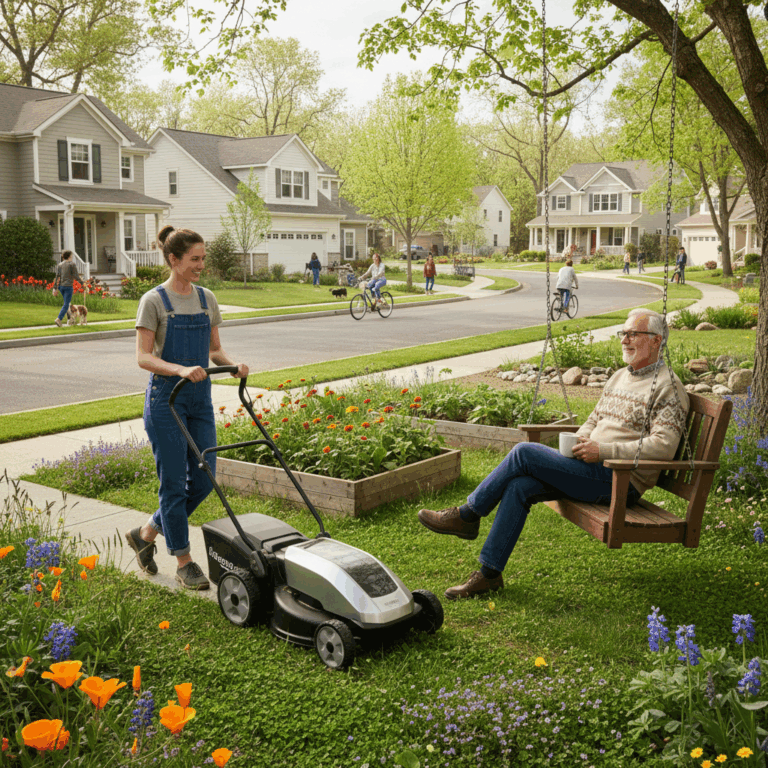
Earth Day 2026: Lawn Care That Actually Helps the Planet
April 4, 2026 · I Want To Mow Your Lawn
Earth Day 2026: Lawn Care That Actually Helps the Planet
There’s a quiet shift happening in yards across America. The obsession with the perfect lawn—the monoculture of perfect grass, treated with chemicals, mowed weekly—is giving way to something more practical, more resilient, and honestly, more beautiful.
This Earth Day, as communities gather for cleanups and environmental action, it’s worth pausing on something that sits right in front of most homes: the yard itself. Lawn care done thoughtfully isn’t just about aesthetics anymore. It’s about water conservation, air quality, soil health, and habitat. And it turns out, sustainable lawn care often means less work, not more.
The Scale of Lawn Care’s Environmental Impact
Americans spend approximately $61.7 billion annually on lawn care. That investment touches everything from fossil fuel consumption to water usage to chemical runoff. Outdoor irrigation alone accounts for nearly one-third of all residential water use in the United States, according to the EPA. In regions facing drought—like Colorado’s Front Range—that pressure is even more acute.
But here’s the encouraging part: the shift toward sustainable lawn care isn’t a sacrifice. It’s an upgrade.
Battery Power Reshapes the Game
Electric mowers have crossed a tipping point. Battery-powered equipment now claims 32% of the lawn care market, up from 18% in 2020. Performance has caught up completely—the best battery mowers now outperform top-rated gas models, with run times of 70 minutes or more. Multiple battery options provide 45-50 minute run times, sufficient for most residential yards.
The environmental wins are tangible. Operating a gas mower for one hour produces pollutants equivalent to driving a car for over 100 miles. Electric mowers eliminate that toxic output while running at 60-75 decibels, compared to gas engines at roughly 90 decibels. For neighbors and the people maintaining these yards, that’s a marked improvement in air quality and noise.
The EPA and California Air Resources Board are phasing out gas mowers by 2035. The transition is already underway.
Rethinking the Lawn Itself
Beyond equipment, the landscape itself is evolving. Clover lawns—particularly microclover—require significantly less water, stay green through drought, and need minimal mowing. They fix their own nitrogen, reducing fertilizer dependency and lowering maintenance costs. White clover produces nectar-rich flowers that feed bees and pollinators throughout spring and summer.
Native plants are gaining mainstream adoption for the first time at scale. A wildflower meadow supports 3.6 times more plants and insects than a manicured lawn. Native species are pre-adapted to local climate and soil, barely need water once established, and create actual habitat for butterflies, bees, and local insects. In Colorado, blue grama grass, buffalo grass, and western wheatgrass thrive with minimal water while supporting regional wildlife. Similar native alternatives exist in every climate zone—buffalograss in the central U.S., sedge grasses in New England, curly mesquite in arid regions.
The Connection to Community Care
Sustainable lawn care practices matter most for people facing physical or financial barriers to yard maintenance. For an older adult who can no longer safely climb a ladder, a veteran returning to an overgrown property, or a neighbor managing a disability, yard work becomes a source of stress rather than pride.
That’s where volunteer lawn care enters the picture. Organizations like I Want To Mow Your Lawn connect 1,800+ volunteers across all 50 states with neighbors in need, providing free yard care that restores safety, dignity, and community connection. Volunteers often bring eco-friendly equipment and practices along with their labor, normalizing sustainable choices within neighborhoods.
A single volunteer visit does more than cut grass. It removes hazards, signals that someone cares, and demonstrates that environmental stewardship and neighbor care aren’t separate concepts—they’re linked.
Getting Started This Earth Day
Whether as a homeowner, volunteer, or community member, there are concrete steps to take:
If managing a yard: Consider replacing high-maintenance grass with clover, native plants, or drought-tolerant alternatives suited to local climate. Even a partial transition reduces water use, maintenance time, and environmental impact.
If upgrading equipment: Electric mowers have reached parity with gas in performance. The shift is practical, not sacrificial.
If wanting to help: Volunteer lawn care connects neighbors directly. A few hours of volunteer work removes barriers to outdoor space maintenance for people who need it most.
Sustainable lawn care isn’t a fringe movement—it’s becoming the baseline. And the best part: it aligns environmental care with human care. Yards that require less water, less fuel, and less chemical input also tend to be yards that are accessible to more people, managed more equitably, and connected to actual community.
This Earth Day, that connection is worth celebrating.
Want to make a difference in your neighborhood? Volunteers help older adults, veterans, and neighbors maintain safe, healthy outdoor spaces. Sign up to volunteer or learn more by playing the MOW app at iwanttomowyourlawn.com/play, available on the App Store.
The Sustainable Yard Conversion Guide: Practical Steps from Clover to Native Plants
Ready to transform a traditional lawn into something lower-maintenance, water-smart, and habitat-rich? This guide walks through concrete techniques, timeline expectations, and common pitfalls—so volunteers and homeowners can make informed choices.
Understanding Your Starting Point
Before making changes, assess the current yard. Note sun exposure (full sun vs. shade), existing soil condition, drainage patterns, and current water usage. Take photos from multiple angles. This baseline matters because not every lawn replacement works for every space. A shaded corner may need sedges rather than sun-loving clover. Clay soil requires different prep than sandy loam.
Clover Lawns: The Fastest Transition
Microclover is the easiest entry point. It can be overseeded into existing grass without killing the base lawn—simply scarify the existing grass lightly, spread microclover seed at 1-2 pounds per 1,000 square feet, water consistently for 2-3 weeks until germination, then allow to establish for 4-6 weeks before regular mowing. Mow at 2.5-3 inches to encourage flowering. Microclover requires no fertilizer after establishment, uses 30-40% less water than traditional grass, and produces nectar for pollinators continuously from spring through frost.
Common mistake: applying seed to compacted soil. Soil prep (light aeration or scarification) is non-negotiable. Another: mowing too short. Let microclover grow—it’s tougher and prettier at height.
Native Plant Meadows: The Longer Play
Converting a lawn section to native plants takes 2-3 years but requires virtually no maintenance after year two. Spring is optimal timing. Remove sod by hand or with a sod cutter (rent locally for $40-80/day), or solarize the area by covering with black plastic for 6-8 weeks in hot months to kill the root system naturally. Loosen exposed soil to 4-6 inches.
Select 5-8 native species suited to local climate and soil type. For Colorado’s Front Range: blue grama grass, blanket flower, coneflower, bee balm, and native milkweed. In New England: sedge, black-eyed susan, and joe-pye weed. Space plants 18-24 inches apart depending on mature size. Mulch between plants with 2-3 inches of wood chips.
First year: water weekly unless rainfall exceeds 1 inch. Second year: water during drought only. Third year onward: virtually hands-off except for annual spring cutback. One critical point: resist tidying too aggressively. Dead stems and leaf litter provide overwintering habitat for beneficial insects.
Equipment Choices for Sustainable Yards
Battery-powered mowers excel on mixed clover-grass lawns and maintained native sections (mow once annually or bi-annually). For taller meadows, a string trimmer or scythe works better. Robotic mowers (battery-powered) can handle clover lawns effectively and reduce labor by up to 40%, though they’re a larger upfront investment ($1,500-3,500).
A practical compromise: start with a quality battery mower (40-50 minute runtime costs $300-600), use it for spring/summer maintenance, and hand-trim edges with a cordless string trimmer. Zero fossil fuel, minimal noise, fully charged in 30-60 minutes.
Water Management: The Single Biggest Impact
If doing one thing for sustainability, prioritize water reduction. Mature native plants need zero supplemental water in most regions once established. Clover lawns use 30-40% less water than monoculture grass. Upgrade irrigation (if present) with smart controllers that adjust for rainfall and season—potential water savings: 20-50%.
For volunteers helping with yards: educate homeowners about hand-watering establishment-phase plants rather than installing permanent irrigation. A soaker hose and timer ($20-40) beats a full irrigation system for most residential conversions.
Timeline Realism
Clover overseeding: visible results in 4-6 weeks. Full establishment: 3-4 months. Native meadow conversion: 2-3 years to full maturity, but beautiful in year one. Volunteers can help with the heavy work (sod removal, soil prep, initial planting) during a single intensive visit or two follow-up sessions spaced seasonally.
Connecting Knowledge to Neighbor Care
Volunteers who understand these conversions can offer meaningful guidance alongside physical help. A neighbor may feel overwhelmed by a yard transformation but will feel empowered if a volunteer explains the timeline, shows what native plants look like at various growth stages, and demonstrates that less maintenance actually means more beauty and habitat over time. That combination—physical help plus education—builds lasting community confidence in sustainable practices.
Support our foundation to unlock this resource
A donation of any amount unlocks all bonus guides, templates, and deep dives for 30 days.
100% goes toward connecting volunteers with neighbors in need.
Choose your donation amount
$
Choose how to donate:
I Want To Mow Your Lawn Inc. is a 501(c)(3) nonprofit and registered charity with PayPal Giving Fund. EIN: 85-3447661. Your donation is tax-deductible.
Have a group?Organize a Community Service Day — we'll match your team with neighbors who need help.
Want to help us reach more neighbors?Our Marketing Toolkit has copy-ready posts, press materials, and flyers you can share in five minutes.